

#146: Your Microservice Landscape Needs a Single Door
And how the Edge Server Pattern Tames Distributed System Complexity

Social engineering is about manipulating people's emotions. Identify the susceptibilities that hackers use to exploit people.

This NINJIO Insights Report dives into the key emotional susceptibilities that make social engineering work and offers concrete steps that your security team can take to equip your workforce to resist cyberattacks.
Microservices promise modularity. You decompose a system into small, focused services, each owning its domain, each deployable independently. It sounds clean. Then you look at the network diagram and realize that every service has a public address, every team is implementing JWT validation in their own way, and refactoring a single service boundary requires coordinating changes across four different client teams.
That is not a distributed system. That is a distributed mess with extra steps.
The edge server pattern exists to fix this at the architectural level. The idea is straightforward: all external traffic enters your system through one controlled point. Everything behind it is private. One door in, many rooms inside. This article goes deep on what that actually means in practice, why the benefits compound as your system grows, and what you are genuinely giving up in exchange.
The Problem with Open Borders
Imagine a typical early-stage microservices setup. The product team exposes port 8081. The review service is on 8082. The recommendation engine lives at 8083. Your frontend knows these addresses. Your mobile app knows them. A few third-party partners have been given direct integration URLs. Everyone is talking to everyone, and it works well enough to ship.
Now the problems start accumulating, and they are not obvious until they hurt.
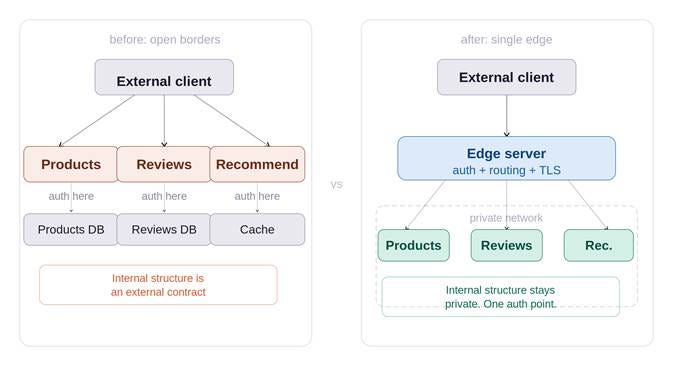
Fig. 1: Open borders vs. a single edge. On the left, every service is reachable and must handle auth independently. On the right, the edge is the only entry point.
Security becomes a distributed responsibility
When every service is externally reachable, every service has to handle authentication. In practice this means each team implements their own token validation logic, maintains their own secret rotation process, and writes their own integration tests for auth edge cases. The surface area for misconfiguration grows linearly with the number of services.
A single service that skips a validation check, misconfigures a CORS header, or accidentally exposes a debug endpoint becomes a gap in the entire system. You cannot audit security policy in one place because there is no one place. You have to review every service independently and trust that every team got it right every time.
Internal structure leaks into external contracts
Suppose the product service has grown large enough that the team wants to split it: one service handles product metadata, another handles inventory. Internally this is a clean refactoring. Externally it is a breaking change for every client that has been hitting /product-service/ directly.
You now have three options, none of them good: freeze the refactoring until you can coordinate a client migration, run the old service indefinitely as a shim, or accept that you will break integrations. The real problem is not the refactoring; it is that you let internal structure leak into external contracts in the first place. Direct service access makes that inevitable.
Network security becomes exponentially harder
Every externally reachable service needs its own firewall rules, its own TLS certificate, its own rate limiting configuration. For five services this is manageable. For twenty it is a full-time job. For fifty it is a source of chronic incidents. Services that have no business accepting external traffic, internal caches, configuration stores, event buses, still need to be deliberately locked down rather than simply unexposed.
“The fundamental issue is not any single vulnerability or misconfiguration. It is that an open-border architecture makes deliberate exposure the exception and accidental exposure the default. The edge server inverts that.”
What an Edge Server Actually Does
At its core, an edge server is a reverse proxy. External requests arrive, the edge inspects them and routes them to the right internal service. Clients never know the internal topology. But a reverse proxy is just the foundation. A well-implemented edge server is doing several distinct jobs simultaneously.
Path-based routing
The most fundamental capability is routing requests based on their URL path. A request to /product-composite/** goes to the product composite service. A request to /eureka/** goes to the discovery server. These rules live in configuration, not in client code, which means they can change without clients noticing.
This is more powerful than it first appears. Your internal service might live at an address that makes sense to your infrastructure team but would be meaningless or confusing to external consumers. The edge lets you present a URL structure that reflects your API design, not your deployment topology. The two do not have to match.
spring: cloud: gateway: routes: - id: product-composite uri: lb://product-composite predicates: - Path=/product-composite/** - id: eureka-web uri: http://eureka:8761 predicates: - Path=/eureka/**
Notice lb://product-composite. The lb:// scheme tells the gateway to resolve the service via the load balancer, which in a Spring Cloud setup means using service discovery. The edge does not need to know the IP address of the product composite service; it just asks the registry for a healthy instance and routes there. This means your edge routing config stays stable even as services scale up, move, or restart.
Service hiding
Not every service should be reachable from outside. Your order processing service, your internal event bus adapter, your ML feature store: these components exist to serve other services, not external consumers. In an open-border setup you have to actively lock them down. With an edge server, they simply have no externally routable address. They exist behind the edge and are unreachable by definition.
Centralized authentication and authorization
Rather than implementing JWT validation in every service, you implement it once at the edge. The edge verifies the token signature, checks expiry, and rejects unauthorized requests before they ever reach your internal network. Internal services can then trust that any request they receive has already been authenticated.
This is sometimes taken further with header propagation: the edge extracts claims from the token and forwards them as headers (X-User-Id, X-User-Roles) so internal services have user context without re-parsing the token themselves. Each service still makes its own authorization decisions based on those headers, but the cryptographic verification happens exactly once.
Centralizing authentication at the edge does not mean internal services should blindly trust everything they receive. Defense in depth still applies. But it does mean you have one authoritative place where external identity claims are verified.
HTTPS termination and protocol handling
External clients always communicate over HTTPS with the edge. What happens internally is an implementation detail. The edge terminates TLS, handles certificate renewal, and communicates with internal services over HTTP on a private network. This means internal services do not each need their own certificates, do not each need TLS configuration, and do not each introduce latency from TLS handshakes on every inter-service call.
Graceful failure handling
When an upstream service is unavailable, the alternative to a well-configured edge is that the raw error propagates directly to the client: a 500 with an internal stack trace, a connection timeout with no explanation, a response body that includes your service class names and database schema details.
The edge is the right place to intercept upstream failures and decide what the external representation should look like. A cached response for read-heavy endpoints that can tolerate slight staleness. A structured error response that tells the client what went wrong without revealing internal state. A degraded response that returns partial data when one upstream is down but others are healthy.
Routing Rules as Design Decisions
One thing that becomes apparent quickly when you start working with an edge server: the routing configuration is not just plumbing. Every decision you make about URL structure, versioning, and predicate logic is a decision about how you want the outside world to think about your system.
URL structure as API design
The path you expose externally does not have to match your internal service name. You can expose /api/v1/products while internally routing to a service called product-composite-v3. You can version your public API independently of your internal deployment cadence. You can reorganize your internal services without changing a single external URL, as long as you update the routing rules.
This separation matters most when you are managing third-party integrations. External consumers build against your URLs. If those URLs map directly to internal service names, every internal refactoring becomes a negotiation with your consumers. If they map to stable, intentionally designed API paths, you keep full control over your internal evolution.
Predicate-based routing beyond paths
Path matching is the baseline. Route predicates let you go further. You can route based on the hostname in the request, which is useful for supporting multiple environments through a single edge deployment with different backend targets. You can route based on request headers, which is the foundation for several useful patterns:
Canary deployments: route requests with a specific header (X-Beta-User: true) to a new version of a service, while all other traffic goes to the stable version.
A/B testing: route a percentage of traffic based on a user segment header, without any changes to the services themselves.
Client-specific routing: route mobile clients (detected via User-Agent) to a backend optimized for mobile response shapes, while web clients hit a different implementation.
The routing layer is where you manage change without breaking things. A feature flag, a traffic split, a version migration: all of these can be implemented at the edge without touching a single service deployment.
Selective Exposure: The Discovery Server Example
One decision that reveals the real nature of the edge server is what to do with internal infrastructure. Take the service discovery server (Eureka, Consul, or similar). It is primarily an internal component: services register with it, other services query it to find healthy instances. There is no reason for external clients to interact with it directly.
But operators have a legitimate need to observe its state. When something is misbehaving, you want to know: which instances are registered? Which are reporting as healthy? Which went missing in the last five minutes? Completely blocking external access to the discovery server means operators cannot check this without SSH access to the internal network.
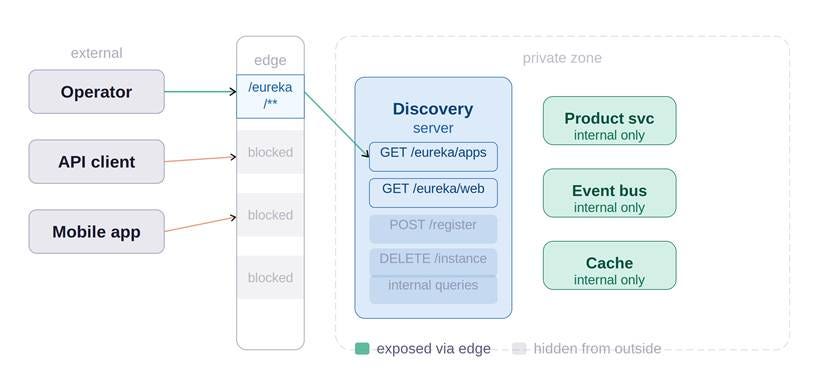
Fig. 2: Only the read-only /eureka/** endpoints are exposed through the edge. Registration, deletion, and internal query endpoints stay private.
The solution is selective exposure. Route a read-only subset of the discovery server API through the edge under a controlled path:
- id: eureka-web uri: http://eureka:8761 predicates: - Path=/eureka/**
Operators can now hit /eureka/apps to see registered services, or pull up the Eureka web UI at /eureka/ for a visual status overview. The broader discovery infrastructure (registration endpoints, internal service-to-service queries) stays private. You expose exactly the surface that serves a legitimate external use case, and nothing more.
This is the right mental model for the edge server across every service in your system. The question is never just ‘should this be external or internal?’ The question is ‘which specific surface of this service needs to be external, and to whom?’ The edge gives you the precision to answer that per endpoint rather than per service.
Tradeoffs and Practical Considerations
Availability
Edge servers are stateless, so the single-point-of-failure concern is manageable: run two or three instances behind a load balancer and failover is fast. The risk is real but the mitigation is straightforward.
Performance overhead
The extra hop is typically single-digit milliseconds and rarely the bottleneck. The bigger concern is thread management under high throughput. Reactive implementations like Spring Cloud Gateway (Project Reactor) handle this well since they never block a thread waiting on an upstream response.
Local development friction
The most underestimated tradeoff. With an edge in the mix, services need to be registry-discoverable, which complicates local runs. Solve it with a full Docker Compose stack, a dev-mode bypass config, or by stubbing the edge in tests. Painful only if you leave it unplanned.
Edge server vs. API gateway
Same architectural pattern, different feature depth. A lightweight edge server (Spring Cloud Gateway, Nginx, Traefik) covers routing, auth, and protocol management, which is enough for most internal systems. A full gateway product (Kong, Apigee, AWS API Gateway) adds per-consumer rate limiting, developer portals, and billing integration. Worth it only if the API itself is a product.
Key Takeaways
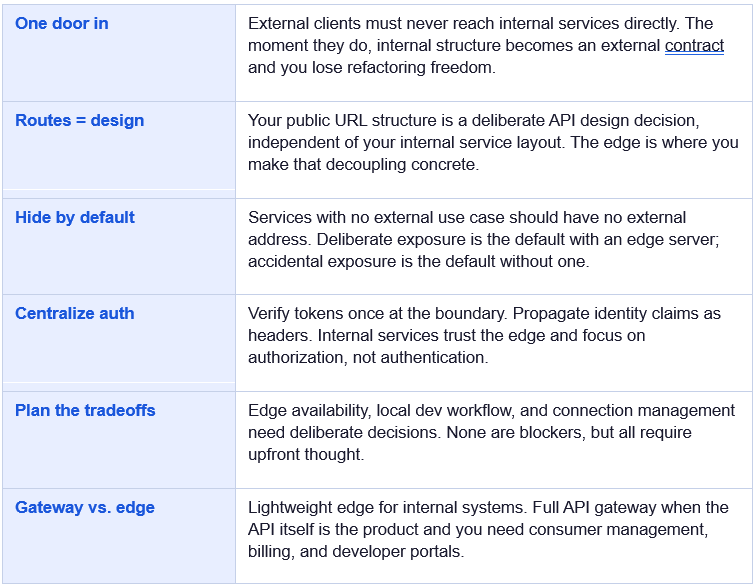
The single-door principle is one of those constraints that feels unnecessary until you have operated a system without it. Once you have spent time debugging a security misconfiguration on service nine of fifteen, or coordinated a client migration because an internal refactor broke a public URL, the value of a single controlled entry point becomes very clear. Start with the edge, even when your system is small. The habits it enforces scale. The problems it prevents do not announce themselves until it is too late.
This Week in the News
⚡ Cloudflare Workers Now Live in 60 Seconds, No Account Needed: Run wrangler deploy --temporary and get a live Worker instantly. It stays up for 60 minutes, and you can claim it to make it permanent. Exactly the kind of friction removal that makes agents and fast-moving developers happy.
🗂️ Polygraph Gives AI Agents a Map of Your Entire Codebase: Built by the Nx team, Polygraph indexes every repo you have access to and maps how they connect through packages and APIs, effectively turning scattered codebases into a synthetic monorepo. It’s a meta-harness for agents, not an agent itself, and it comes with cross-session memory. Free during early access.
📖 MDN Now Has an Official MCP Server for Your Coding Agent: MDN’s new MCP server pipes its documentation and browser compatibility data directly into your editor or IDE. Your LLM gets accurate, current web platform info instead of pulling from stale training data when writing HTML, CSS, or JavaScript. A quiet but meaningful upgrade for AI-assisted web development.
🤖 Vercel’s Eve Is an Open-Source Framework for Building Serious Agents: Eve brings durable execution, sandboxed compute, human-in-the-loop approvals, and evals to agent development. An agent is just a directory where each file describes one component, making the structure easy to read at a glance. Vercel-native by default, but fully portable with your own keys.
🚧 React Compiler’s Rust Integration Gets Pulled Over Binary Size Bloat: Integrating the React Compiler natively into Oxc was the right performance call, but the binary size ballooned enough to affect all Rolldown and Vite users. The integration has been temporarily pulled while the team works on slimming it down. Doing the right thing the hard way.
Beyond the Headlines
⚔️ The Framework Wars Are Happening Again, This Time for AI Agents: React beat batteries-included contenders by doing one thing well, and Next.js grew on top to supply the rest. The same pattern is playing out in AI agents: narrow agents will win, and a meta-harness layer will grow above them. A sharp read from the Nx team on where the agent ecosystem is headed.
🔁 The Harness Loop: Where Autonomous Agents Work and Where They Don’t: A harness-level loop sits outside the agent loop. Work goes into a queue, a machine picks it up, attempts it, and the harness decides whether to continue, inject another message, or start fresh with modified context. Great for porting code, performance explorations, and security scanning, but tends to produce overly defensive code when left entirely hands-off. A thoughtful, honest take from Armin Ronacher.
🌿 Git Worktrees: The 2015 Feature That AI Agents Just Made Relevant: Git worktrees let you check out multiple branches simultaneously without stashing or switching context. They have been around for a decade but are suddenly essential now that AI coding agents need to work across branches in parallel. A solid explainer if you have never reached for this feature before.
🧱 JavaScript Still Can’t Install a Full-Stack Module: Rails and Laravel let you install a package that ships a full vertical slice: backend, frontend, and database model, all wired up and ready to go. JavaScript still can’t do this. It matters for AI agents too, since models work better with pre-built, well-tested modules that hide complexity behind a thin interface rather than hand-rolling everything from scratch. A well-argued case from the Wasp team on a gap the JS ecosystem hasn’t closed.
📊 WebAssembly Runtimes Benchmarked in 2026: Less Hype, More Numbers: A benchmarking follow-up tracking whether WebAssembly runtimes have actually gotten faster year over year. Wasmer comes out as the best overall performer, with WAVM, WAMR, and Wasmtime close behind. The new wide_arithmetic instructions are proving to be a significant boost for crypto code on runtimes that support them. Exactly the kind of update the Wasm ecosystem needs.
Developer Toolbox
🥷 Kage: Clone Any Website Into a Static, Offline Mirror: Kage (影, "shadow") renders pages through headless Chrome, captures the fully assembled DOM, then strips out every script, event handler, and network call. CSS, images, and fonts are downloaded and rewritten to local paths so the offline copy looks identical to the live site. One command to clone, one to serve. A pure-Go binary with no dependencies and no fuss.
That’s all for this week. Have any ideas you want to see in the next article? Hit Reply!
Cheers!
Editor-in-chief,
Kinnari Chohan
👋 Advertise with us
Interested in sponsoring this newsletter and reaching a highly engaged audience of tech professionals? Simply reply to this email, and our team will get in touch with the next steps.