

WebDevPro #133: Rethinking Backend Communication for Real-Time Systems
Crafting the Web: Tips, Tools, and Trends for Developers

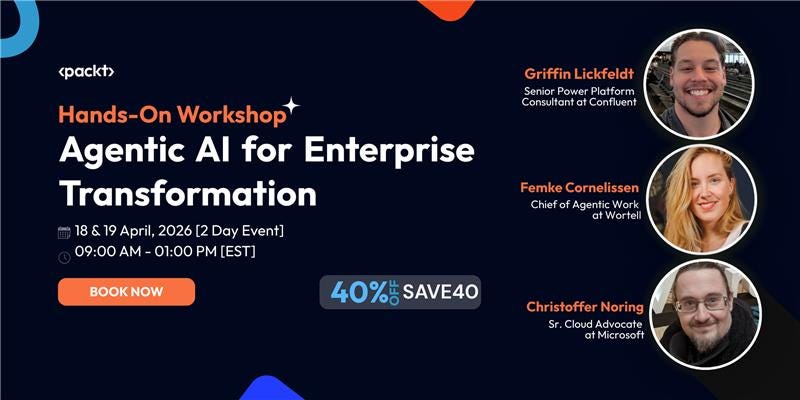
Job postings at Microsoft, Deloitte, Accenture, and KPMG are now listing Copilot Studio, Power Automate, and MCP as must-have skills. The fastest way to get there?
Build a real enterprise AI agent in 2 days LIVE, with instructors from Microsoft and Confluent.
Welcome to this week’s issue of WebDevPro!
Most backend systems are built around a simple assumption: the client asks, the server responds, and the connection ends. That model has worked for decades because it fits neatly with how the web evolved. It scales well, it’s easy to reason about, and most infrastructure is designed around it.
But the moment you step into real-time features, that assumption starts to break.
Chat apps, collaborative tools, live dashboards, multiplayer systems, and even notifications all share one requirement: the server needs to speak without being asked. That single shift changes how you design your backend, how you think about state, and how you handle communication altogether. This is where event-driven systems enter the picture.
Before we get into it, here’s this week at a glance:
🤖 AI debugging shifts toward agent-driven workflows at Sentry
⚡ Trigger.dev reports major performance gains after switching to Bun
Where Request-Response Falls Short
Consider a typical chat system built with REST:
Fetch messages with GET /messages
Send messages with POST /messages
Poll regularly to check for updates
Polling is the problem. You either:
Poll frequently and waste resources, or
Poll less often and introduce lag
Even long polling only stretches the same model. The client is still responsible for initiating communication.
Event-driven systems remove that constraint. Instead of asking repeatedly, the client stays connected and receives updates as they happen.
Persistent Connections Change the Rules
WebSockets make this possible by keeping a connection open between client and server. Both sides can send messages at any time.
This introduces three key shifts:
Communication becomes bidirectional
The server can initiate updates
The connection now carries state
That last point is the tradeoff. Stateless systems are easy to scale. Stateful connections require you to manage:
Connection lifecycle
Reconnection
Failure handling
You gain responsiveness, but complexity increases.
Why Abstractions Like Socket.IO Matter
WebSockets provide the foundation, but they are intentionally minimal. Production systems need more than just a raw connection.
Socket.IO adds:
Automatic reconnection
Fallback to long polling
Event-based APIs
Broadcasting and grouping
Logical channels via rooms
This shifts your backend from handling endpoints to handling events.
Thinking in Events Instead of Endpoints
In REST, you design routes and responses. In event-driven systems, you design interactions.
Instead of:
POST /messages
GET /messages
You work with:
socket.emit(’chat.message’, message)

socket.on(’chat.message’, (msg) => {
// handle message
})
The server becomes an event hub, and clients react to changes as they occur. This model aligns better with systems where state evolves continuously.
Broadcasting and Scope
A core capability of event-driven systems is broadcasting:
io.emit(’chat.message’, payload)
This allows one event to reach many clients instantly. But sending everything to everyone rarely works in practice. You need scope. Rooms provide that control:
socket.join(room)
io.to(room).emit(’chat.message’, payload)
This lets you:
Segment users
Isolate conversations
Reduce unnecessary updates
Rooms are not just a feature. They are how you model context in real-time systems.
When You Still Need Responses
Event-driven systems are asynchronous by default, but not everything fits that model. Sometimes you need a response, such as fetching user data or validating an action. Socket.IO supports this through acknowledgments:
const userInfo = await socket.emitWithAck(’user.info’, socket.id)
This creates a hybrid model where event-driven flows and request-response patterns coexist. In practice, most systems rely on both.
Authentication Becomes a Connection Concern
In REST, authentication happens per request. With persistent connections, it happens during the handshake:
io.use((socket, next) => {
// verify token
})
Once established, the connection is trusted. This introduces new questions:
What happens when tokens expire? How do you revoke access in real time? How do you store credentials securely?
Even token storage becomes more critical, as insecure storage mechanisms can expose credentials.
Authentication is no longer a repeated check. It becomes part of connection management.
The Tradeoff: State and Scaling
The biggest difference between REST and event-driven systems is state. REST systems are stateless, which makes scaling straightforward. Any server can handle any request. Event-driven systems maintain active connections. That means:
Servers track clients
Messages must reach specific connections
Load balancing becomes more complex
At scale, this often requires additional infrastructure like shared message layers or coordinated routing. This is where the simplicity of REST becomes hard to replace.
Choosing the Right Model
Event-driven systems are not a replacement for REST. They solve a different class of problems. They work best when:
Data changes frequently
Users expect immediate updates
Interaction is continuous
They add unnecessary complexity when:
Data is mostly static
Caching is effective
Real-time behavior is not critical
A blog platform benefits from REST. A collaborative editor does not. Instead of focusing on tools, focus on interaction patterns, ask:
Does the server need to push updates?
Do users depend on real-time feedback?
Is the system driven by events rather than requests?
If yes, an event-driven approach is worth the tradeoff.
Key Takeaways
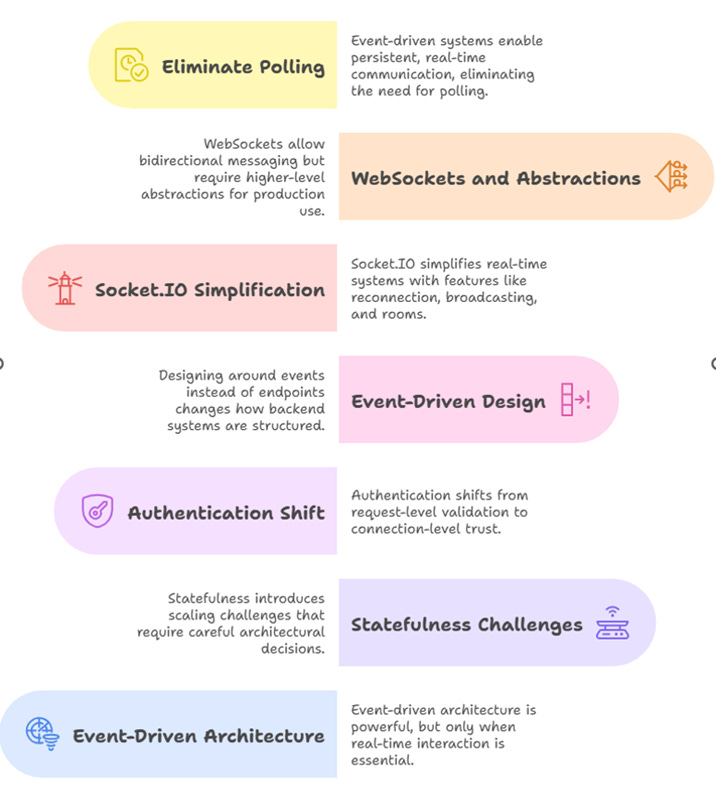
Real-time systems are less about adopting new tools and more about changing how you think about communication. Once the server is no longer passive, the entire shape of your backend begins to evolve.
If you want to explore how these concepts come together in a full application, Modern Full-Stack React Projects by Daniel Bugl is a solid next step.
This Week in the News
🤖 Cursor 3 introduces a unified workspace for coding with agents: Cursor 3 is a full redesign built around managing AI agents in one place. You can run multiple agents in parallel, move work between local and cloud, and go from generated changes to merged PRs without leaving the interface. The shift is not about replacing coding. It is about raising the level of abstraction. You spend less time juggling tools and more time coordinating how work gets done.
⚙️ Next.js is finally decoupling from Vercel: Next.js is making a clear move toward platform independence. The new Adapter API creates a shared contract that lets any provider support Next.js reliably, backed by a public test suite and collaboration across Cloudflare, Netlify, AWS, and more. The direction is hard to miss. Next.js is no longer just a framework tied to one deployment model. It is becoming an infrastructure that can run anywhere without compromises.
🛠️ Sentry is turning debugging into agent workflows: Sentry’s new cookbook is a collection of ready-made “agent recipes” designed to help AI systems find, debug, and fix issues faster. Instead of treating observability as a dashboard, it becomes something agents can act on directly. The direction is clear. Debugging is no longer just about seeing errors. It’s about giving agents the context to resolve them automatically.
⚠️ Copilot briefly inserted an ad into a pull request: A developer noticed Copilot had edited an unexpected ‘ad’ into a PR, raising questions about how AI tools modify code. GitHub’s Martin Woodward later clarified what caused the behavior and confirmed the feature has now been disabled. It’s a small incident, but a reminder that AI-assisted coding still needs clear boundaries and visibility.
🧩 Run Codex inside Claude Code: The Codex plugin brings OpenAI’s Codex directly into Claude Code, combining two AI systems into a single workflow. It allows developers to delegate tasks like code reviews and bug fixes to background jobs while continuing to work. The interesting shift here is orchestration. Instead of one assistant, developers are starting to coordinate multiple agents for different tasks.
☁️ Cloudflare is building a WordPress alternative for the edge: Cloudflare’s EmDash is positioned as a modern successor to WordPress, designed to run on Cloudflare’s edge or any Node.js server. It focuses on performance, simplicity, and a more developer-friendly architecture. The bigger signal is where platforms are heading. Content systems are moving closer to the edge, with infrastructure and CMS becoming tightly integrated.
Beyond the Headlines
🧠 What it’s like to actually use Claude Code: Claude Code is getting attention, but this deep dive looks past the hype into how it actually behaves in real workflows. From code navigation to multi-step reasoning, the experience feels less like autocomplete and more like collaborating with a system that understands intent. The gap between writing code and orchestrating it is starting to shrink.
📦 npm workspaces finally make sense: As projects grow beyond a single folder, things start to break. Shared code drifts, dependencies duplicate, and workflows get messy. This guide breaks down how npm workspaces actually solve that by managing multiple packages in one repo with shared dependencies and seamless imports. The value is not just convenience. It is about building systems that scale without turning your codebase into a maintenance problem.
🔥 Trigger.dev got 5x performance by replacing Node with Bun: Trigger.dev swapped Node.js for Bun in a latency-critical service and saw throughput jump from ~2k to over 10k requests per second. The deeper insight is not just speed. It shows how runtime choices are starting to matter again, especially for systems handling high concurrency and long-lived connections.
🔍 Why ChatGPT waits before you can type: A deep reverse-engineering effort by Buchodi digs into why ChatGPT sometimes blocks input until a background check completes. The analysis suggests Cloudflare’s Turnstile is not just verifying the browser, but checking whether the app itself has properly initialized, including parts of the React state. The bigger shift is subtle but important. Bot detection is moving beyond “is this a real browser” to “is this a real user interacting with a real app.”
Tool of the Week
📺 Build your own YouTube-style player with ArtPlayer (demo)
ArtPlayer is a full-featured HTML5 video player that gives you fine-grained control over the playback experience. From custom controls and subtitles to plugins and styling, it is designed to be deeply customizable without adding unnecessary complexity.
If you need more than a basic video tag but don’t want to build everything from scratch, this strikes a practical middle ground.
That’s all for this week. Have any ideas you want to see in the next article? Hit Reply!
Cheers!
Editor-in-chief,
Kinnari Chohan
👋 Advertise with us
Interested in sponsoring this newsletter and reaching a highly engaged audience of tech professionals? Simply reply to this email, and our team will get in touch with the next steps.